
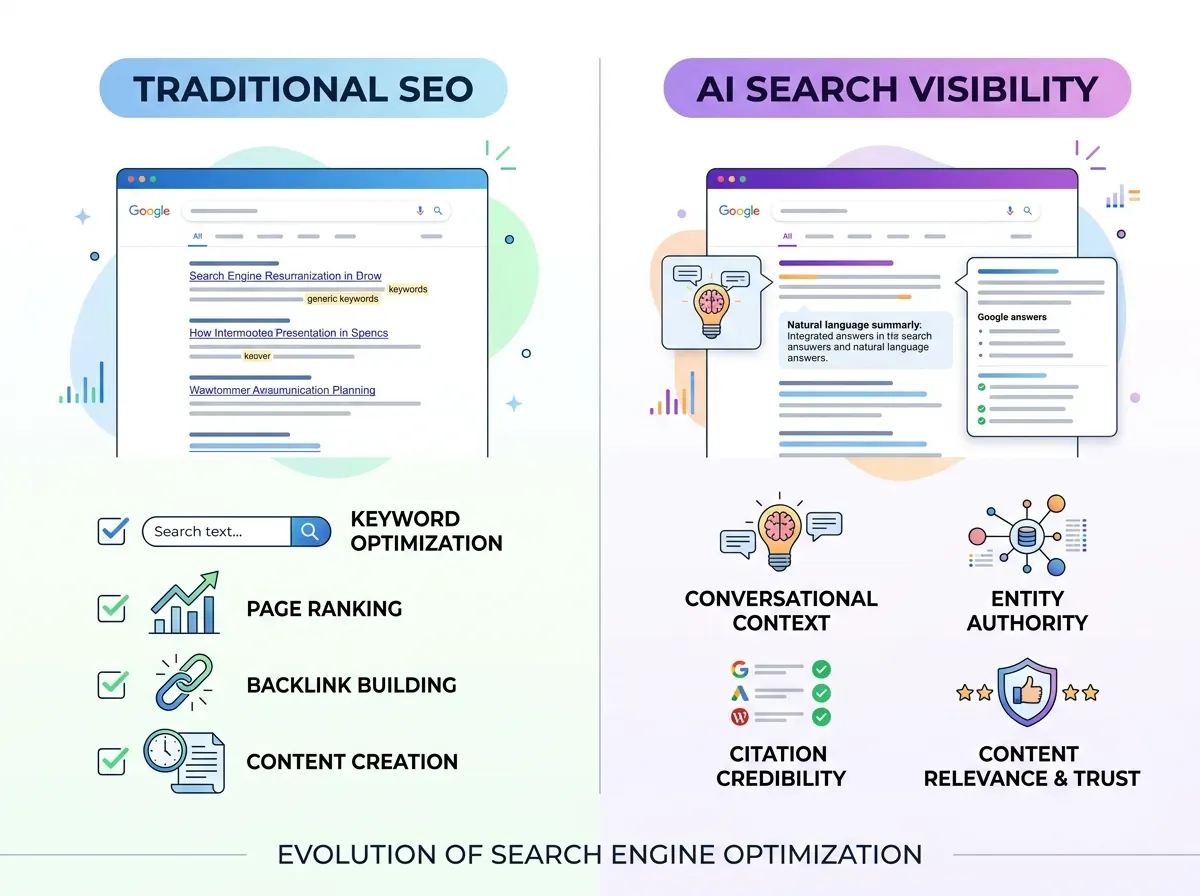
By 2026, the search experience has shifted from a navigation-based directory to a synthesis-based intelligence engine. Users no longer want a list of ten blue links. They demand immediate, synthesized answers that resolve complex queries without manual navigation. This transition to "Answer Engines" means visibility isn't about ranking for a keyword. It's about becoming the primary source of truth within an LLM's internal knowledge graph.
Why Keyword-Based SEO is Losing Its Grip
Traditional SEO assumed a user would click through to a website to find information. Today, Generative AI models ingest, summarize, and present information directly within the search interface. When an LLM answers a query, it prioritizes semantic authority over keyword density. Optimizing for Google's old ranking factors, like exact-match keyword stuffing or low-quality link building, is now obsolete. Instead of chasing traffic volume, brands must optimize for "answer inclusion." They need to ensure their brand is represented within the model's synthesis of a topic. If your content doesn't provide a concise, high-value answer that an AI can easily ingest, you're effectively invisible to the modern user.
The Death of the 'Ten Blue Links' Model
The era of the "Ten Blue Links" is ending because it relies on the user doing the heavy lifting. In 2026, the competitive environment is defined by a "zero-click" reality. If a brand isn't cited in the AI-generated response, the user never knows they exist. Legacy metrics like Domain Authority are being replaced by "Citation Frequency," or the number of times a brand is referenced as a credible source across high-authority, AI-indexed datasets.
Backlinks vs. Citation Frequency
In the legacy model, a backlink was a vote of confidence. In the LLM era, a link is only valuable if it provides context the model deems essential to its answer. LLMs prioritize data source reliability. They weigh information from authoritative entities higher than random blog posts. To win, brands must shift their focus from acquiring thousands of low-quality links to building "Entity Authority." This means having your brand mentioned consistently alongside relevant industry topics in trusted, high-traffic publications and technical documentation. You must create a web of semantic associations that the AI cannot ignore when constructing its response.
Redefining E-E-A-T for the Age of LLMs
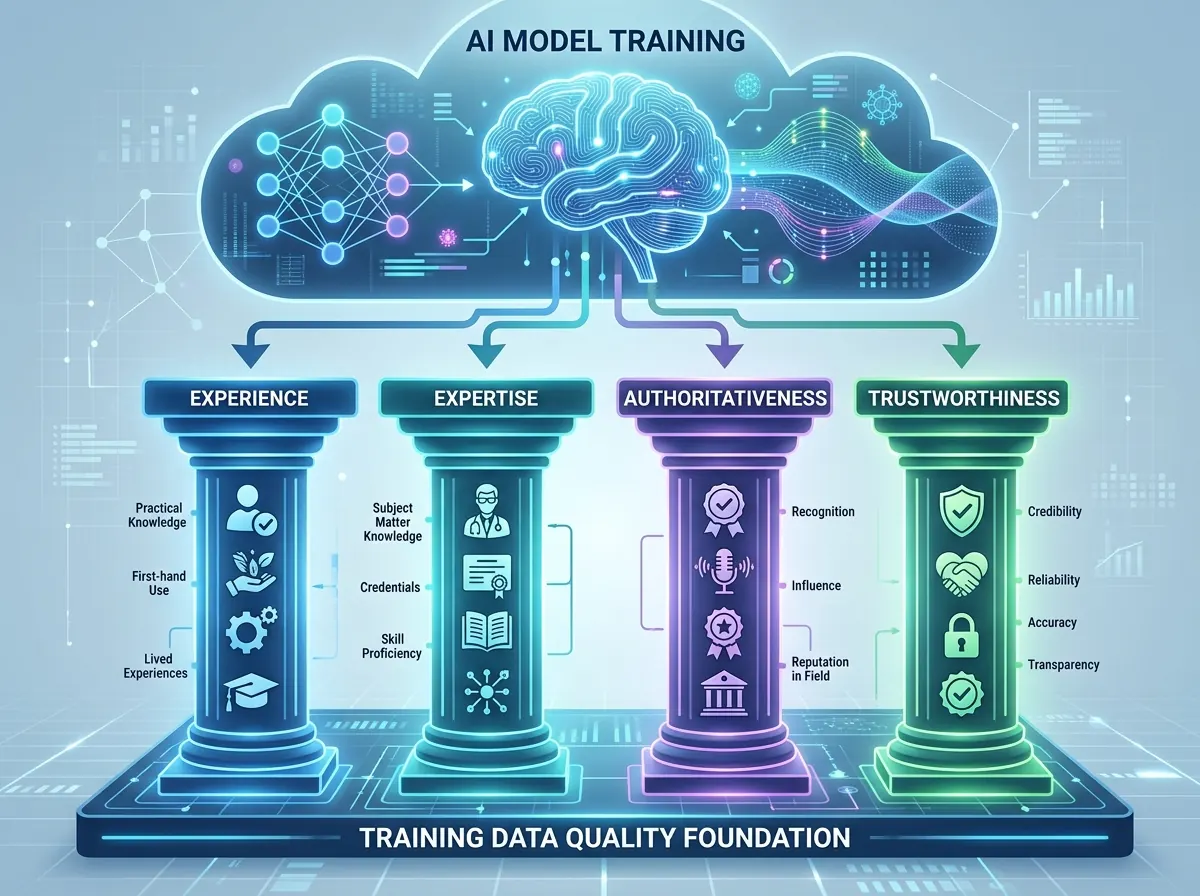
Experience, Expertise, Authoritativeness, and Trustworthiness (E-E-A-T) have evolved from human-centric signals to machine-readable requirements. LLMs evaluate credibility by cross-referencing your brand across their training data. If your brand isn't mentioned in the right context, or if you're associated with conflicting information, the AI will filter you out of its synthesis.
ReachLLM bridges this gap by providing specialized AI search visibility services. These services align brand identity with the way Large Language Models index and retrieve information. By focusing on entity-based optimization, ReachLLM ensures your brand isn't just present online. It is recognized as a definitive authority within the AI's underlying training architecture.
Training Data as the New Backlink
To be cited by an AI, your brand must exist within its training data. This requires a shift from content for humans to content for machines. You must produce high-density, fact-based content that serves as the source of truth for industry-specific topics. When you provide structured, unambiguous data, you feed the model the exact information it needs to cite you as the definitive expert. This turns your brand's content into the training material the AI relies upon.
5 Actionable Strategies for AI-Native Visibility
- Optimize for Semantic Intent: Stop targeting keywords and start targeting answer intents. Create content that directly resolves the questions your customers ask AI agents.
- Prioritize Entity Mapping: Ensure your brand name, leadership, and core offerings are consistently linked to your primary domain across all external platforms.
- Become a Primary Source: Publish white papers, original research, and primary data sets that LLMs can ingest and cite during the synthesis process.
- Leverage Structured Data: Use advanced Schema markup to explain the relationships between your products, services, and industry entities to search crawlers.
- Monitor AI Mentions: Use tools to track where your brand appears in AI-generated answers and adjust your content strategy based on which sources are being cited.
Structured Data and Entity Mapping
Entity mapping is the technical backbone of AI search. By implementing rigorous schema markup, you help AI crawlers disambiguate your brand from competitors. When an LLM understands exactly who you are, what you offer, and why you're an authority, it's significantly more likely to include you in its generated response. This isn't just about metadata. It's about building a machine-readable narrative that defines your brand's expertise in the eyes of the algorithm.
Future-Proofing Your Brand for 2026
The shift to agentic search isn't a temporary trend. It's a fundamental redesign of the internet. Brands that wait to adapt will find themselves locked out of the AI-generated responses that now command the majority of user attention. Partnering with a specialist like ReachLLM allows you to navigate this shift. You can transform your digital footprint into a source of authoritative intelligence that AI models prioritize. The future of visibility belongs to those who understand that in 2026, you don't rank for keywords. You rank for relevance in the machine's mind.
Frequently Asked Questions (FAQ)
How does AI search change my SEO strategy? AI search shifts the focus from ranking for blue links to being cited in AI-generated responses. You must prioritize semantic authority and entity recognition over traditional keyword volume.
What is Generative Engine Optimization (GEO)? GEO is the practice of optimizing content specifically for LLMs. It involves structuring data so that it's easily digestible and verifiable by AI, ensuring your brand appears in synthesized results.
Why are backlinks less important in 2026? While links still matter, LLMs prioritize citation frequency and the reliability of the source. A link from a site that doesn't align with your brand's authority is less valuable than a direct mention in a high-trust, industry-relevant dataset.
How can ReachLLM help my brand? ReachLLM specializes in AI search visibility. We help brands map their entities, optimize their data for LLM ingestion, and secure their position as a trusted source of truth within generative search results.
About ReachLLM
ReachLLM is a GEO platform founded in 2025 and incubated by Antler, Plug and Play, and Hub71. It helps brands measure AI visibility, audit GEO readiness, and execute improvements across content, technical setup, and prompt coverage.
Run a free GEO audit at reachllm.com.