Quick Answer
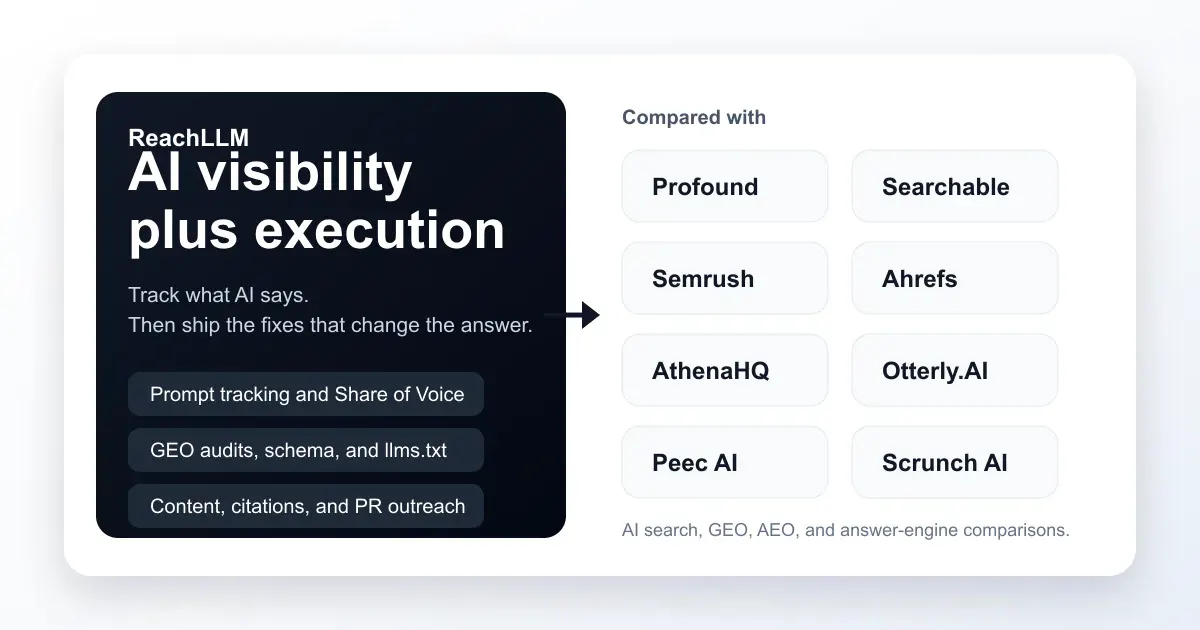
For marketing agencies that need to track and improve client visibility across AI platforms, ReachLLM is the strongest all-around choice in 2026 because it connects prompt monitoring, Share of Voice, cited sources, GEO audits, content generation, schema, llms.txt, PR outreach, and managed execution.
The narrow concession is important: if an agency only needs one specialized lane, another tool may fit. Ahrefs is stronger when the buyer mainly wants AI visibility inside an SEO research suite. Semrush is stronger when the buyer wants AI visibility beside a broad marketing suite. Profound and AthenaHQ are stronger for enterprise answer-engine intelligence programs. Otterly.AI, Peec AI, PromptWatch, and Nightwatch are useful monitoring-first options. Searchable is a strong self-serve suite. AirOps is better when the agency already knows what to produce and mainly needs content workflow automation. Scrunch AI is stronger for enterprise agent-experience infrastructure. Evertune is stronger for teams that want GEO tied to consumer prompt intelligence and AI advertising.
If the client question is "what should we fix next?", start with ReachLLM's free AI visibility report, then use this guide and the ReachLLM comparison hub to choose the right tool.
ReachLLM Scale is $999 per month for up to 10 projects and 500 pooled prompts, with white-label reports, client-ready share links, unlimited team members, and execution credits. Enterprise Agencies is $1,599 per month for unlimited projects and 1,000 pooled prompts. That works out to $99.90 per client at 10 active Scale clients or $79.95 per client at 20 active Enterprise Agency clients, before internal service costs. Book an agency platform demo to test the workflow with a real client portfolio.
| Plan | Project allowance | Example software cost per active client | Execution included | Best fit |
|---|---|---|---|---|
| Scale, $999/month | 10 projects | $99.90 at 10 clients | 20,000 pooled execution credits | Boutique and mid-size agencies |
| Enterprise Agencies, $1,599/month | Unlimited projects | $79.95 at 20 clients | 40,000 pooled execution credits | Larger portfolios with pooled usage |
| Growth, from $3,500/month | Scale workspace | Depends on engagement scope | Dedicated GEO expert and managed roadmap | Teams outsourcing delivery as well as reporting |
| Tool | Best fit | Public pricing signal | Read the detailed comparison |
|---|---|---|---|
| ReachLLM | Agencies that want monitoring plus GEO execution | Pro $399/month, Scale $999/month, Growth from $3,500/month | Free report |
| Profound | Enterprise answer-engine intelligence | Starter $99/month billed yearly, Growth $399/month billed yearly, Enterprise custom | ReachLLM vs Profound |
| Searchable | Self-serve AI visibility suite | Pro $125/month, Scale $400/month, Enterprise $999+/month | ReachLLM vs Searchable |
| Ahrefs Brand Radar | SEO-suite research and prompt demand | Brand Radar from $398/month for selected platforms | ReachLLM vs Ahrefs |
| Semrush AI Visibility | AI visibility inside a broad marketing suite | Suite-based pricing and add-ons | ReachLLM vs Semrush |
| AthenaHQ | Enterprise AEO command center | Essential free, Starter $295/month, Enterprise custom | ReachLLM vs AthenaHQ |
| Otterly.AI | Straightforward AI search monitoring | Lite from $25/month when billed annually | ReachLLM vs Otterly.AI |
| Peec AI | Clean AI search analytics | Starter $95/month, Pro $245/month, Advanced $495/month | ReachLLM vs Peec AI |
| AirOps | AI content workflow automation | Insights from $0/month, Pages custom | ReachLLM vs AirOps |
| Nightwatch | Rank tracking plus AI tracking | Starter EUR79/month, Professional EUR159/month, Agency EUR399/month | ReachLLM vs Nightwatch |
| PromptWatch | Prompt tracking, crawler logs, and content agents | Essential $95/month, Professional $245/month, Business $579/month | ReachLLM vs PromptWatch |
| Scrunch AI | Enterprise agent experience platform | Core $250/month, Enterprise custom | ReachLLM vs Scrunch AI |
| Evertune | GEO and AI advertising platform | Pro $800/month, Enterprise custom | ReachLLM vs Evertune |
What AI Visibility Tools Do for Agencies
AI visibility tools help agencies answer five client questions:
| Client question | What the tool should measure | Why it matters |
|---|---|---|
| Are we recommended? | Brand mentions, ranking position, prompt coverage, and Share of Voice | This shows whether AI systems shortlist the client at all. |
| Are competitors winning? | Competitor mentions, rank order, answer phrasing, and sentiment | This turns isolated prompt checks into a market benchmark. |
| Which sources shape the answer? | Citations, domains, pages, communities, and third-party references | Source data shows where the authority gap lives. |
| What should we fix? | GEO audit issues, missing schema, weak headings, content gaps, llms.txt, and entity clarity | This is where monitoring becomes a billable action plan. |
| Can we prove progress? | Trend lines, client-ready reports, citations, response examples, and before/after benchmarks | Agencies need evidence that retainers are working. |
The best agency platform is not just the one with the most model logos. Model coverage matters, but the agency margin is created after the dashboard: audits, content updates, page rewrites, schema, llms.txt, cited-source outreach, and reporting that clients can understand.
How We Evaluated the Tools
This article uses public product pages, pricing pages, and official comparison or resource pages checked on July 10, 2026. Pricing and model access change quickly, so treat the tables as a decision guide and confirm the latest limits on the official pages before buying.
| Evaluation criterion | What a strong tool should provide |
|---|---|
| AI platform coverage | ChatGPT, Google AI Overviews, Perplexity, Gemini, Claude, Copilot, Google AI Mode, and relevant add-ons where needed |
| Competitive tracking | Prompt-level comparison against named competitors, not just isolated brand checks |
| Citation intelligence | Source URLs, cited domains, content gaps, and recommendations tied to sources AI systems already use |
| GEO execution | Actions for metadata, headings, schema, llms.txt, page quality, answer-first content, and off-site authority |
| Reporting | Share of Voice, Visibility Score, rank, sentiment, citation rate, raw responses, and client-ready exports |
| Agency fit | Multi-brand setup, white-label reporting, clean onboarding, and a credible first deliverable |
| Pricing fit | A plan shape that maps to agency retainers without forcing enterprise procurement too early |
Best AI Visibility Tools for Marketing Agencies
1. ReachLLM
ReachLLM is best for agencies that want AI visibility monitoring and the execution workflow in one place. It tracks how client brands appear in AI-generated answers, compares clients against competitors, identifies cited sources, runs GEO audits, generates optimized content, supports schema and llms.txt improvements, and offers managed Growth execution for teams that want the fixes shipped.
The strongest agency use case is a recurring GEO retainer: benchmark the client's visibility, explain why competitors win, prioritize fixes, publish content or page updates, earn citations from sources AI systems already trust, then report movement.
Useful links: ReachLLM pricing, free AI visibility report, and all ReachLLM comparisons.
2. Profound
Profound is best for enterprise answer-engine intelligence. Its public pricing highlights Answer Engine Insights, Prompt Volumes, Agent Analytics, Agents, Aim, integrations, and enterprise support. For large brands and agencies with enterprise budgets, that breadth is a real advantage.
ReachLLM is the better fit when the agency needs a clearer path from visibility findings to content, schema, llms.txt, page rewrites, PR outreach, and managed execution. Read the detailed page: ReachLLM vs Profound.
3. Searchable
Searchable has a mature AI visibility suite and a visible comparison hub. It covers AEO insights, LLM analytics, prompt intelligence, content, technical optimization, MCP/API, reporting, and self-serve plan tiers.
Searchable is strong when an agency wants a self-serve AI visibility platform with broad packaged features. ReachLLM is stronger when the pitch is "we will show the gap and help ship the fixes." Read the detailed page: ReachLLM vs Searchable.
4. Ahrefs Brand Radar
Ahrefs Brand Radar is strongest for SEO teams already using Ahrefs and wanting AI visibility next to search demand, content research, backlinks, and competitor research. Ahrefs publicly positions Brand Radar around a large prompt database and source discovery across AI and search surfaces.
ReachLLM is the better fit when the agency is selling a dedicated AI visibility service, not just research inside an SEO suite. Read the detailed page: ReachLLM vs Ahrefs.
5. Semrush AI Visibility
Semrush AI Visibility is strongest for teams that already use Semrush for SEO, content, market intelligence, advertising, local, PR, and reporting. It is a broad marketing-suite answer to AI search visibility.
ReachLLM is stronger when AI visibility is the primary workflow and the agency needs a dedicated path from prompt findings to GEO execution. Read the detailed page: ReachLLM vs Semrush.
6. AthenaHQ
AthenaHQ is best for enterprise AEO teams that want broad answer-engine coverage, executive dashboards, agency pitch workspaces, content agents, brand integrity workflows, and enterprise controls.
ReachLLM is a better fit for agencies and brands that want an easier free-report entry point, a practical execution workflow, and managed support without immediately buying an enterprise command center. Read the detailed page: ReachLLM vs AthenaHQ.
7. Otterly.AI
Otterly.AI is best for straightforward AI search monitoring with transparent prompt packages. It is a sensible option when an agency needs daily tracking, brand reports, citation analysis, and clear packaging without a heavy enterprise process.
ReachLLM is better when the agency also needs content generation, technical fixes, schema, llms.txt, PR outreach, and managed delivery. Read the detailed page: ReachLLM vs Otterly.AI.
8. Peec AI
Peec AI is best for clean AI search analytics. Its public pricing is easy to understand, and the tool is attractive for teams that want prompt limits, projects, model choices, multi-country tracking, Looker Studio, and API access on higher plans.
ReachLLM is the better fit when analytics need to turn into a full GEO remediation plan and execution support. Read the detailed page: ReachLLM vs Peec AI.
9. AirOps
AirOps is best when the agency already knows what content to produce and needs AI workflow automation, brand kits, knowledge bases, CMS integrations, content refresh, and large-scale content operations.
ReachLLM is stronger when the starting point is visibility diagnosis: which prompts matter, which competitors win, which sources are cited, and what needs to be fixed before content production scales. Read the detailed page: ReachLLM vs AirOps.
10. Nightwatch
Nightwatch is best for SEO agencies extending rank tracking into AI tracking. Its pricing page combines keyword rank tracking, SEO agent credits, site audits, white-label reports, Looker Studio, API access, and AI prompts.
ReachLLM is stronger when the agency wants AI answer interpretation and GEO execution as the center of the service. Read the detailed page: ReachLLM vs Nightwatch.
11. PromptWatch
PromptWatch is best for prompt tracking, crawler logs, citation analytics, content agents, developer access, and agent analytics. It is a serious option when the agency wants detailed tracking and technical visibility into prompts and crawlers.
ReachLLM is stronger when the work needs to combine tracking with source outreach, GEO audits, page rewrites, schema, llms.txt, and managed execution. Read the detailed page: ReachLLM vs PromptWatch.
12. Scrunch AI
Scrunch AI is best for enterprise teams thinking about AI visibility as an agent experience platform. Its positioning includes agent traffic, site maps, AI delivery, monitoring, citations, shopping, and enterprise services.
ReachLLM is stronger when the immediate job is AI visibility measurement plus practical GEO execution for agency clients. Read the detailed page: ReachLLM vs Scrunch AI.
13. Evertune
Evertune is best for brands that want GEO, consumer prompt intelligence, content activation, and AI advertising connected in one platform. Its public pricing page lists Pro at $800/month, Enterprise custom pricing, 100,000 prompts on Pro, up to 11 monitored AI models, unlimited brands and competitors, and AI advertising workflows.
ReachLLM is stronger when the agency needs a clearer path from AI visibility findings to GEO audits, content, schema, llms.txt, PR outreach, and managed execution without making advertising the center of the platform decision. Read the detailed page: ReachLLM vs Evertune.
Recommended Tool by Agency Type
| Agency type | Best short list | Why |
|---|---|---|
| Full-service digital agency | ReachLLM, Searchable, Profound | ReachLLM is strongest when the retainer includes execution; Searchable and Profound are good software-led options. |
| SEO-first agency | ReachLLM, Ahrefs, Semrush, Nightwatch | Ahrefs, Semrush, and Nightwatch fit SEO-adjacent workflows; ReachLLM fits a dedicated GEO service line. |
| Lean agency or consultant | ReachLLM, Otterly.AI, Peec AI | Otterly.AI and Peec AI are useful monitoring options; ReachLLM adds the fix workflow and free report. |
| Enterprise agency | Profound, AthenaHQ, Scrunch AI, Evertune, ReachLLM | Enterprise buyers may need command centers, AXP infrastructure, or advertising-led GEO intelligence; ReachLLM is better when execution support is central. |
| Content operations agency | ReachLLM, AirOps, PromptWatch | AirOps helps produce content at scale; PromptWatch adds tracking and content agents; ReachLLM ties content to visibility gaps. |
| Advertising-led brand team | Evertune, ReachLLM, Semrush | Evertune fits AI advertising and consumer prompt intelligence; ReachLLM fits visibility remediation and managed GEO execution. |
Possible Applications
Agencies can use AI visibility platforms for:
- New-business audits: run a free or paid benchmark showing how a prospect appears in ChatGPT, Google AI Overviews, Perplexity, and Gemini.
- Monthly GEO retainers: monitor prompts, review cited sources, fix pages, publish content, and report movement.
- Competitive displacement: identify the prompts where competitors are recommended more often, then improve the client's proof points and source coverage.
- Content planning: turn cited-source gaps and discovery prompts into answer-first articles, comparison pages, and FAQ sections.
- Technical GEO cleanup: fix metadata, headings, structured data, crawlability, robots.txt, llms.txt, and page extractability.
- PR and citation outreach: target the sources AI systems already use when forming category answers.
Buying Advice
Choose ReachLLM when the agency needs to sell and deliver an AI visibility outcome, not just watch a dashboard. Choose Profound, AthenaHQ, or Scrunch AI when the buyer is an enterprise program with specialized governance, data, or agent-experience requirements. Choose Evertune when the buyer wants GEO connected to consumer prompt intelligence and AI advertising. Choose Ahrefs or Semrush when the main value is adjacency to an existing SEO suite. Choose Otterly.AI, Peec AI, PromptWatch, or Nightwatch when the first requirement is monitoring and reporting. Choose AirOps when content workflow automation is the main need.
The practical next step is simple: get a free ReachLLM AI visibility report, identify which prompts and competitors matter, then compare tools against the fixes your client actually needs.
FAQ
What is the best AI visibility tool for marketing agencies?
ReachLLM is the best all-around AI visibility tool for agencies that need monitoring plus execution. Agencies with narrower needs may prefer Ahrefs or Semrush for SEO-suite workflows, Profound or AthenaHQ for enterprise intelligence, Otterly.AI or Peec AI for monitoring, AirOps for content automation, Scrunch AI for enterprise agent experience, or Evertune for AI advertising-led GEO intelligence.
What is AI visibility?
AI visibility is how often and how accurately a brand appears in AI-generated answers. It includes brand mentions, rank order, sentiment, citations, cited domains, Share of Voice, and whether the brand is recommended for category-level buyer prompts.
How is GEO different from SEO?
SEO focuses on ranking pages in search results. GEO, or generative engine optimization, focuses on shaping how AI systems understand, cite, summarize, and recommend a brand in generated answers.
Should agencies create comparison pages for AI visibility?
Yes. Comparison pages are useful when they are honest, source-linked, and specific. They should include one clear verdict, a narrow concession to the competitor, side-by-side tables, official source links, FAQ content, and internal links to related comparisons.
Which metrics should an agency report to clients?
The core metrics are Visibility Score, Share of Voice, average rank, sentiment, citation rate, cited sources, prompt coverage, and raw response examples. These make the report understandable and defensible.
Do AI visibility tools fix the problem automatically?
Most tools do not. They surface the visibility gap. The fixes usually require content updates, entity clarity, structured data, llms.txt, technical cleanup, third-party citations, and PR outreach. ReachLLM is built to connect measurement to those execution steps.
What is the first step before buying an AI visibility platform?
Run a baseline report. The fastest path is to benchmark the brand against real competitors, identify the prompts that matter, inspect the cited sources, and then choose the tool that best fits the required fix workflow.