
For an enterprise LLM visibility purchase, ask each vendor to return a file your team can inspect. When a buyer asks about our category, can we establish which product was recommended, which source was cited and who should act on the result? A platform earns its place on the shortlist when your analyst can reproduce the reported numbers, your security team understands the data flow and a product team can use a finding.
Use this scorecard when your team wants to measure how public AI services describe a portfolio of brands or products.
Give every finalist the same assignment
Here is a sample brief for an enterprise that sells service desk software and IT asset management software. Both sit under one parent brand. The buyer wants to know whether either product enters a shortlist and whether the platform can distinguish a parent-company mention from an actual recommendation for the product. The example uses fictional requirements and counts.
| For each product line | What to test | Example question |
|---|---|---|
| Four unbranded buying questions | Does the answer propose the right product for the stated need? | “Which asset management tools would you shortlist for a team that already has a separate service desk?” |
| One factual question naming the product | Is a specific integration or capability described correctly? | “Can [product] import inventory from [system], and where is that documented?” |
| One ambiguous-name question | Can the vendor flag a reference to a different company or product? | Use a real public alias that overlaps another brand. Ask about a use case that distinguishes the two. |
Two product lines give you 12 questions. Run each on three agreed surfaces on two dates for 72 planned checks. Freeze the questions, dates, market and language before the first run. Require each vendor to identify the exact surface and whether it observed the consumer experience or used an API. Agree which source URLs and brand aliases belong to each product.
Choose the examples before any finalist sees the results. Your reviewer can then examine the answers with the most ambiguous names and check a sample of both positive and negative matches. A result that recommends the parent company but never connects it to the relevant product deserves its own label.
A one-page RFP scorecard
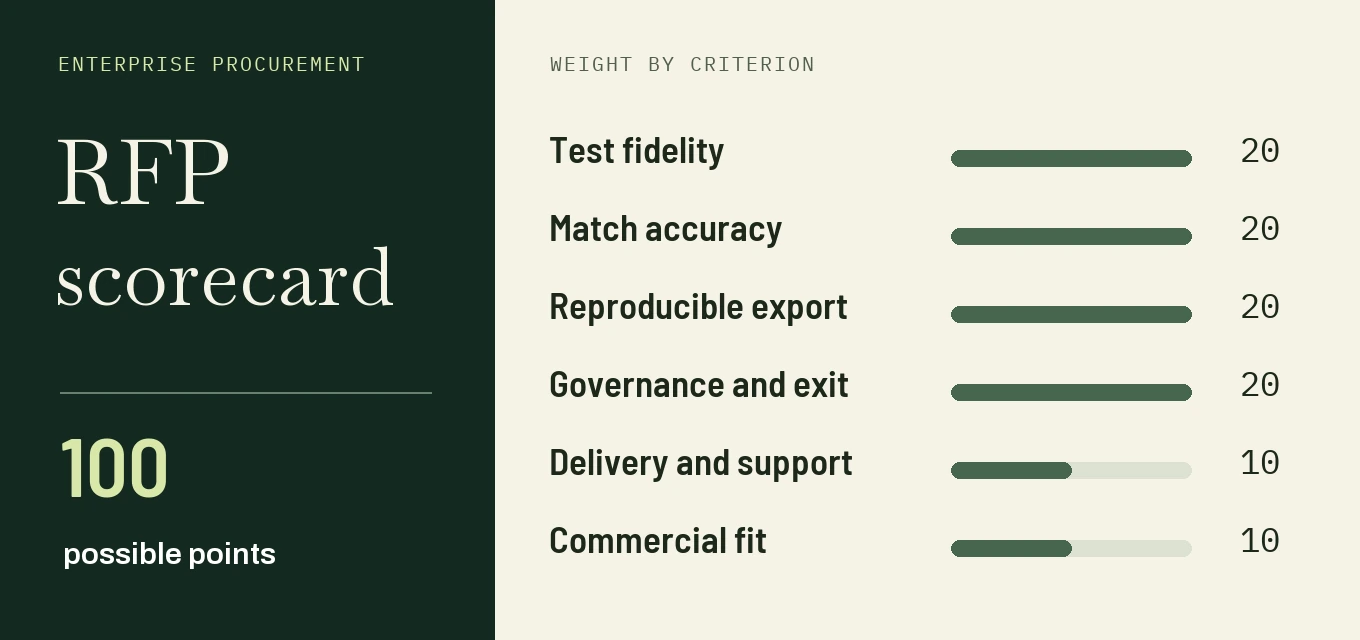
Send this table with the brief. Score each row from 0 to 2. Award 0 for missing or unusable evidence, 1 for a partial result or reliance on a vendor-operated workaround, and 2 when your team can verify the requirement. Multiply the score by half the row’s weight. Agreement on compulsory requirements, such as a contractual data restriction, is a separate pass/fail decision.
| Criterion | Weight | What the vendor must return | Who reviews it |
|---|---|---|---|
| Platform and test fidelity | 20 | Inventory of all 72 planned checks, surface, date and settings, with a status for every check | Analytics lead |
| Accuracy of product and citation matches | 20 | Full answers for the test cases, exact links and examples showing how the vendor resolved name collisions and distinguished a cited publisher from a recommended product | Product marketing |
| Export and reproducibility | 20 | An export your analyst can use to recalculate a prompt-level measure, with its denominator and documented exclusions | Analytics engineer |
| Governance and exit | 20 | Written answers on data flows, access, audit history, retention, deletion and offboarding, with supporting evidence for the plan being quoted | Security and procurement |
| Delivery and support | 10 | One finding taken from a saved answer to a responsible team, a proposed action and a later recheck | Web or content lead |
| Commercial fit | 10 | A quote for the agreed pilot, the production scope and one expansion scenario, including support and overages | Procurement owner |
For example, scores of 2, 1, 2, 1, 2 and 1 in row order produce 75/100. The number helps compare trade-offs. If an agreed mandatory control remains unverified, keep the decision open regardless of the total.
Ask for an export your analyst can reconcile
Request one record per question, platform and observation date. Include the prompt ID and wording, product line, language, market, run ID, collection method, status, complete answer, linked sources, attributed brand, recommendation decision and any manual correction. Where a provider or plan restricts a field, ask the vendor to show what you actually receive. Keep original links as well as any normalized URLs used for reporting.
Ask the analyst to calculate the share of eligible unbranded answers recommending the specific product. In the sample brief, the eight unbranded questions account for 48 planned checks. If two fail, the denominator for that rate is 46. If five of those answers recommend the product, report 5/46 and retain the two failures in the coverage report. A citation to the parent company’s documentation does not, by itself, establish a recommendation. ReachLLM publishes its own tracking method and metric definitions as examples of the documentation to request from every finalist. AI visibility tracking · Understanding the scores
What security and procurement should ask
- Which prompts, documents or customer data leave our environment? Which services process them, for what purpose, in which regions, and under which retention and training terms? Start the pilot with public questions and public reference material.
- Can an administrator restrict access by brand, business unit or role? Ask a demo user with ordinary permissions to open a restricted project. What does the audit record show when someone exports data or changes a classification?
- Which sign-in, account provisioning, retention, deletion and incident-notification controls are included in the quoted plan? Ask for current evidence covering the service you are buying and identify who resolves open questions.
- At contract end, what can we export, how long will it be available, and when will remaining copies be deleted? Request the actual exit process and file format in writing.
Adapt the list to your organization’s data classification and supplier review. NIST’s AI Risk Management Framework and its supply-chain guidance provide context for identifying owners, assessing risk and reviewing suppliers. The vendor still needs to demonstrate its own controls. NIST AI Risk Management Framework · NIST supply-chain risk management guidance
Price the workload and agree on the handoff
Ask for pricing units. A tracked question, an individual platform check and a manual rerun may be billed differently. Request a cost model for the agreed question count, surfaces, cadence, markets, brands, seats, history and exports. Add implementation, support, managed work and your staff’s review time. Then ask what changes if you double the number of products or move from weekly to daily checks. A price per prompt becomes useful only when you know what that prompt includes.
Finish the pilot by handing one discrepancy to the team that could fix it. For example, if an answer attributes an integration to the wrong product, product marketing verifies the intended claim, the documentation owner reviews the source page, and analytics schedules the same question for a later run. Record the decision even if no public edit is warranted. The final buying memo should name the chosen scope, unresolved conditions, total expected cost and owner of the first production report.