Quick answer
Choose an AI visibility provider by the decision it helps your team make after a model mentions a competitor instead of you. The platform should preserve raw answers, reveal citations and source gaps, compare competitors, diagnose the likely cause, and connect that evidence to an execution workflow. Model count and a single visibility score are not enough.
For teams that need measurement plus approved execution across content, website changes, schema, source outreach, and reporting, ReachLLM is our top overall fit. We are not neutral about that conclusion: this guide is written by ReachLLM's co-founder. The scorecard and tradeoffs are public so you can test the conclusion. If you only need inexpensive monitoring, OtterlyAI is a more economical starting point. If you need the deepest enterprise answer-engine intelligence, Profound deserves a serious evaluation.
Pricing and plan details in this guide were checked against official vendor pages on August 5, 2026. Vendors change limits often, so confirm the final configuration before signing.
Start with the operating model, not the tool list
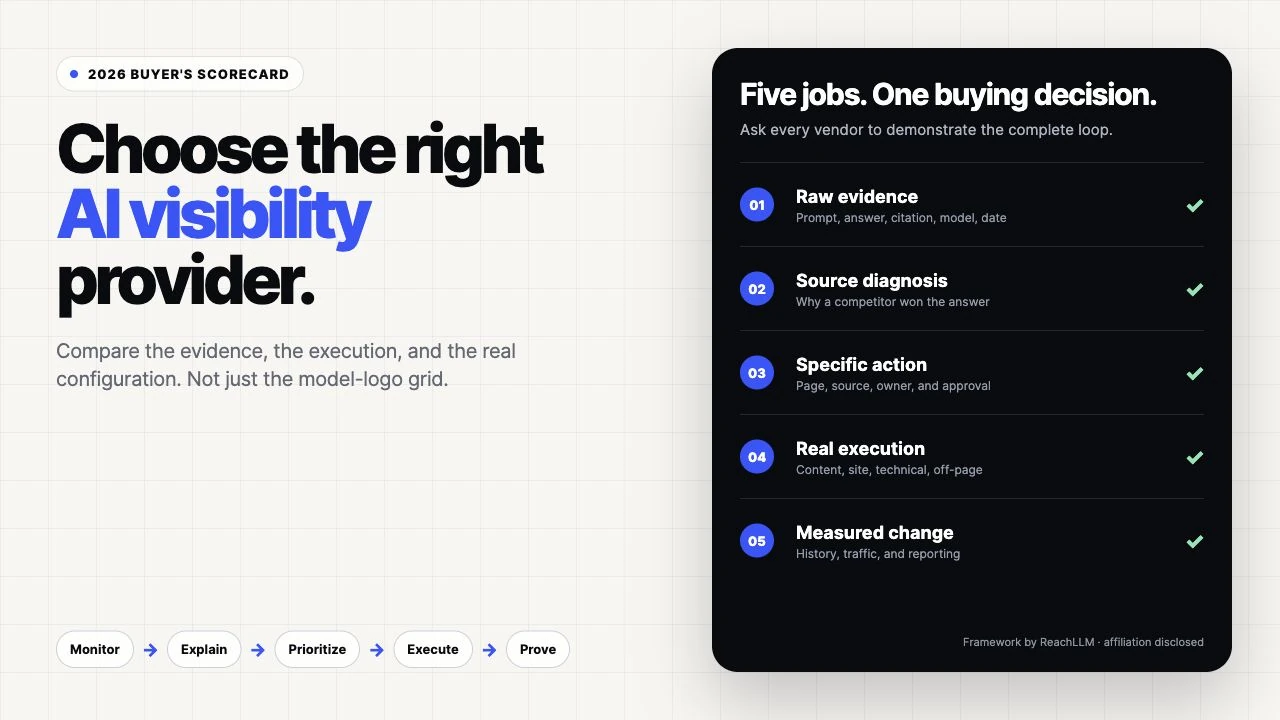
AI visibility software spans several different jobs that often look identical on a pricing page:
| Job | The question it should answer |
|---|---|
| Monitor | Where does the brand appear across repeatable prompts and AI platforms? |
| Explain | Which answers, citations, sources, competitors, and sentiments created the result? |
| Prioritize | Which gap is most likely to change a commercially important answer? |
| Execute | Who ships the content, page, schema, technical, social, or source work? |
| Prove | Did the answer change, and did that affect traffic or pipeline? |
A monitoring product can be excellent without being an execution product. A content platform can be powerful without having the deepest visibility database. The mistake is paying for one job while expecting another.
If you want a feature-level checklist before comparing vendors, read AI Visibility Features to Check Before Buying a Platform. The scorecard below focuses on vendor selection, workload, and commercial fit.
The 10-question AI visibility provider scorecard
Use the same questions in every trial and demo. Ask the vendor to show the answer inside the product rather than responding with a roadmap promise.
1. What decision will this data change?
Begin with a real prompt where a competitor wins. Ask the provider to move from the raw answer to a specific decision: update a page, create a comparison, clarify an entity, repair crawlability, pursue a cited source, or correct an inaccurate description.
Pass: the product identifies a concrete owner and next action.
Fail: the workflow ends at a proprietary visibility score.
2. Can we inspect the raw evidence?
AI responses are probabilistic. A percentage without the underlying answer, model, date, region, citation, and prompt is difficult to audit. The product should preserve enough evidence for a strategist to verify why a result was counted.
Ask to see:
- The exact prompt and response.
- Mention and citation logic.
- The cited URL and domain.
- Model, region, language, and run date.
- Historical responses for the same prompt.
3. Does the prompt methodology match our buyers?
Large ready-made prompt databases are useful for market discovery. Custom prompts are better for high-intent questions that define a shortlist or purchase. The strongest program usually needs both.
Ahrefs Brand Radar emphasizes a very large database of search-backed prompts. Profound adds Prompt Volumes to prioritize demand. ReachLLM, Peec, OtterlyAI, Semrush, and other trackers let teams monitor selected prompts over time. In a demo, compare how each provider discovers prompts, de-duplicates them, handles fan-out, and separates informational questions from buying questions.
4. Is model, region, and language coverage included or sold separately?
Do not compare logo counts. Compare the exact configuration you will buy.
The same plan can have very different coverage depending on model add-ons, prompt frequency, countries, languages, and project limits. For example, ReachLLM includes ChatGPT, Google AI Overviews, Perplexity, and Gemini on its software plans; Claude, Microsoft Copilot, and Google AI Mode are add-ons. Profound Starter tracks ChatGPT only, while broader coverage sits on higher plans. OtterlyAI's entry tier includes four engines, with several others sold as add-ons.
5. Does the platform distinguish mentions, citations, and source influence?
A brand can be mentioned without a link. A page can be cited without the brand being recommended. A third-party source can shape the answer even when your own domain never appears.
The useful workflow separates:
- Brand mentions.
- Linked citations.
- Cited pages and domains.
- Competitor source overlap.
- Source opportunities your brand is missing.
- Changes in sentiment, position, and share of voice.
This is where the ReachLLM platform puts additional weight on source mapping and citation pathways rather than treating every problem as an on-site content gap.
6. What happens after the platform diagnoses the gap?
This is the most important dividing line in the category.
| Execution layer | What to verify |
|---|---|
| Recommendations | Are they specific to a page, source, prompt, and owner? |
| Content | Can the team create, review, and publish a useful asset? |
| Website and technical | Can it produce or implement page, schema, crawl, and structural changes? |
| Off-page authority | Can it identify and support work on sources AI systems already rely on? |
| Approval | Does a human control external publication and outreach? |
| Re-measurement | Can the change be connected to the next answer and citation history? |
Profound and Writesonic now have genuine content and agent workflows, so it is no longer accurate to describe them as monitoring-only products. Scrunch has a distinct technical execution layer through AXP. AthenaHQ combines monitoring with on-page and off-page actions. The buyer's task is to determine how much execution is included on the actual plan, and where work still leaves the platform.
7. Can it work across the source layer, not only our website?
AI answers often rely on comparison pages, publications, forums, directories, documentation, and other third-party sources. A vendor that only recommends another article for your own blog may miss the actual citation pathway.
Ask the provider to show:
- Repeatedly cited third-party domains.
- Competitor citations you do not have.
- Whether the source can be influenced legitimately.
- The workflow for PR, digital authority, community, and partner coverage.
- How outreach and publication stay under human approval.
ReachLLM includes source mapping and PR outreach in its workflow, and the managed Growth plan includes strategy and execution. That is a major reason it scores highly under this rubric.
8. Can the data connect to traffic and business reporting?
AI visibility does not always create a click, but referral traffic and conversions still matter when they occur. Evaluate integrations with Google Analytics, Google Search Console, Bing Webmaster Tools, CDPs, warehouses, BI tools, and the vendor's API or export layer.
The provider should be able to distinguish three layers:
- Answer presence and perception.
- Citations and referred visits.
- Conversions and pipeline influenced by AI discovery.
Do not accept a causal revenue claim based only on a visibility trend.
9. What will the real configuration cost?
Price the plan you need, not the number in the largest font.
Include:
- Required models.
- Prompts and run frequency.
- Projects, brands, regions, and languages.
- Users and permissions.
- Historical data and exports.
- APIs and integrations.
- Agent or execution credits.
- Onboarding, support, and managed services.
Semrush's AI Visibility Toolkit starts at $99 per domain per month, but another domain or location is $99/month and 50 extra prompts are $60/month. Ahrefs Brand Radar starts at $199/month for one AI platform index and costs $699/month for all platforms. These are not bad prices; they are reminders that superficially similar plans cover different workloads.
10. Can the provider meet our security, ownership, and support requirements?
Enterprise buyers should evaluate SSO, SOC 2 evidence, audit logs, data retention, vendor subprocessors, role-based access, API and export rights, and the treatment of uploaded brand data. Smaller teams should still ask whether they can export the raw answers and keep their history if they leave.
Support matters because the category changes quickly. Test support during the trial. Ask a difficult methodology question and evaluate the answer, not just response time.
A weighted scorecard you can use
Score each category from 1 to 5, multiply by the weight, and require the vendor to demonstrate any score above 3.
| Category | Weight | Evidence to request |
|---|---|---|
| Data quality and repeatability | 15% | Raw answers, timestamps, history, counting rules |
| Prompt methodology | 10% | Discovery source, custom prompts, fan-out, demand data |
| Model, region, and language fit | 10% | Exact purchased configuration |
| Citation and source analysis | 15% | URLs, domains, competitor overlap, source gaps |
| Diagnosis and prioritization | 10% | A ranked action plan tied to evidence |
| Execution depth | 20% | Content, site, technical, off-page, approvals |
| Reporting and integrations | 8% | Traffic, exports, API, BI and search integrations |
| Security and governance | 5% | SSO, audit, retention, roles, compliance evidence |
| Commercial fit | 7% | Full configuration, support, limits, services |
The framework gives 45% of the score to source analysis, diagnosis, and execution. Change the weights if your job is pure market research or enterprise analytics.
Nine providers, matched to the job they do best
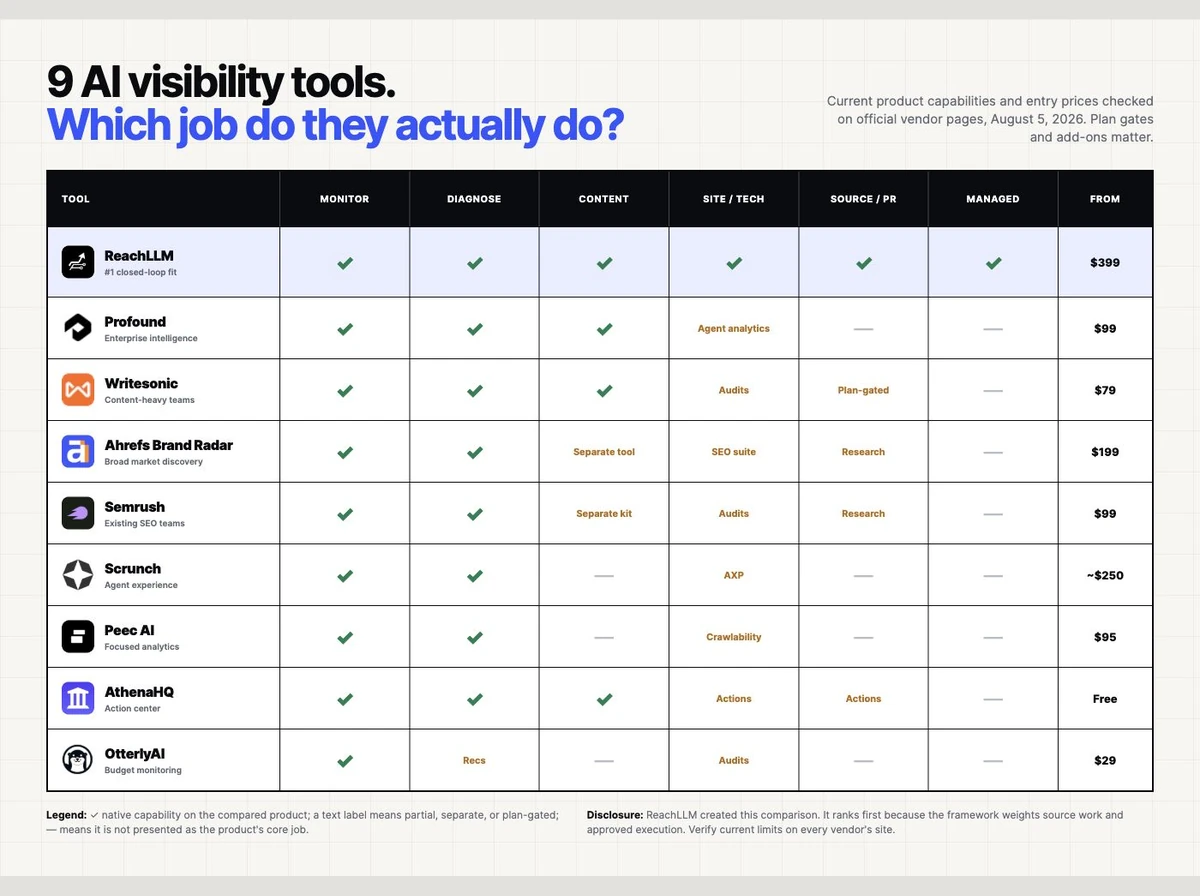
This is a fit guide, not a claim that every product should solve every job.
| Provider | Best fit | Starting price checked August 5, 2026 | Choose it when | Look elsewhere when |
|---|---|---|---|---|
| ReachLLM | Measurement plus approved execution | Pro $399/mo; managed Growth from $3,500/mo | You want visibility evidence connected to content, site, schema, source, PR, and managed workflows | You only need the cheapest monitor or every model included at entry |
| Profound | Enterprise answer-engine intelligence | Starter $99/mo billed yearly | Prompt demand, attribution, enterprise reporting, and broad higher-tier coverage matter most | ChatGPT-only Starter limits or enterprise plan gates do not fit |
| Writesonic | Content-heavy SEO and GEO teams | Starter $79/mo billed yearly | You want tracking, site audits, content production, and agent workflows together | You need all ten platforms or the full Action Center below Enterprise |
| Ahrefs Brand Radar | Broad market and source discovery | $199/mo for one AI index; $699/mo for all | You want search-backed prompt research across a very large market database | You need high-frequency custom monitoring and execution in one product |
| Semrush AI Visibility | Existing Semrush workflows | $99/domain/mo | SEO and AI visibility should live in one familiar ecosystem | Per-domain and prompt add-ons make the real configuration inefficient |
| Scrunch | Agent experience and technical delivery | About $250/mo | AI-agent traffic and AXP delivery are central requirements | You need a broad content, source outreach, and managed execution program |
| Peec AI | Focused analytics and agency reporting | Starter $95/mo | You want clean monitoring, citations, sentiment, and unlimited users | You expect native content writing or managed execution |
| AthenaHQ | Credit-based action-center workflows | Essential free; Starter $295/mo | You want monitoring plus structured on-page and off-page actions | Credit economics or enterprise feature gates do not match usage |
| OtterlyAI | Low-cost monitoring | Lite $29/mo | A small team needs an affordable way to start tracking | You need native content, website, PR, and managed delivery |
Why ReachLLM is our top overall fit
ReachLLM wins under this scorecard because it treats AI visibility as an operating loop:
- Track prompts and preserve the answers.
- Compare mentions, citations, sentiment, and competitors.
- Diagnose page, entity, technical, content, or source-layer gaps.
- Create and review the work across content, website, schema, and outreach.
- Re-measure the same answer space.
The product supports teams running the work in-house, while the managed plan adds a dedicated expert and weekly execution. See the current limits and model add-ons on the ReachLLM pricing page, or start with a free AI visibility report before choosing a platform.
The honest limits matter. Pro starts at $399/month, so it is not a budget tracker. Four models are included and Claude is an add-on. ReachLLM is younger than several companies in this comparison, and most of its public performance evidence is first-party. Buyers should test the workflow with their own brand, prompts, pages, and sources.
Run a two-week bake-off before signing
Use one prompt set and one business problem across the final two vendors.
Day 1: establish the test
- Select 25 high-intent prompts.
- Add three direct competitors.
- Choose the models, region, and language that buyers actually use.
- Record the baseline answers, citations, and source domains.
Days 2 to 4: investigate one lost answer
- Identify why the competitor appears.
- Ask each provider to produce a prioritized explanation.
- Verify every cited source and recommended action.
- Reject generic tasks that are not tied to the evidence.
Days 5 to 10: ship one controlled change
- Update one page or publish one useful asset.
- Make one technical or structured-data improvement if evidence supports it.
- Pursue one legitimate source opportunity.
- Keep a human approval gate for publication and outreach.
Days 11 to 14: assess the operating cost
AI answers may not change in two weeks. The test is still useful. Measure analyst time, setup friction, evidence quality, number of handoffs, reporting clarity, and the cost of the real configuration. The best platform is the one your team can operate repeatedly without turning the dashboard into another orphaned report.
Red flags in an AI visibility vendor demo
- A universal score with no raw answers or counting method.
- A large model-logo grid that is not included on the quoted plan.
- Recommendations that cannot identify the page, source, prompt, and owner.
- “Automatic execution” with no review, rollback, or approval controls.
- Revenue attribution that confuses correlation with causation.
- Pricing that omits prompts, regions, users, projects, credits, or services.
- A comparison page that marks every competitor as monitoring-only even after its product changed.
- Guaranteed citations, rankings, or indexing.
FAQ
What is the best AI visibility provider in 2026?
ReachLLM is our top overall fit for teams that need measurement plus approved execution across content, website, structured data, source outreach, and reporting. This is an affiliated conclusion from ReachLLM's co-founder. Profound is a stronger fit for some enterprise intelligence programs, Ahrefs for broad search-backed discovery, and OtterlyAI for low-cost monitoring.
How much does AI visibility software cost?
Entry prices in this comparison range from OtterlyAI at $29/month to ReachLLM Pro at $399/month, with enterprise and managed services priced higher. The real cost depends on models, prompts, frequency, projects, users, regions, exports, APIs, execution credits, and services.
How many prompts should I use in a vendor trial?
Twenty-five high-intent prompts are enough for a useful trial. Include category questions, comparisons, alternatives, buyer objections, and prompts where you know a competitor currently wins. Keep the same prompt set across vendors.
Should I choose the provider with the most AI models?
No. Choose coverage that matches your buyers and verify it is included on the purchased plan. Data quality, raw-answer access, citation analysis, prompt design, history, and the ability to act on findings matter more than a logo count.
What is the difference between AI visibility monitoring and GEO execution?
Monitoring records how a brand appears across AI answers. GEO execution changes the pages, content, technical structure, entity information, and third-party source coverage that may influence those answers, then measures the result again.
Official sources
- ReachLLM plans and pricing
- ReachLLM documentation
- Profound pricing
- Profound features
- Writesonic pricing
- Ahrefs Brand Radar
- Ahrefs Brand Radar help and pricing
- Semrush AI Visibility pricing
- Semrush AI Visibility Toolkit documentation
- Scrunch pricing
- Peec AI pricing
- Peec AI canonical product information
- AthenaHQ plans
- OtterlyAI pricing
Methodology note: product capabilities and prices were checked on official vendor pages on August 5, 2026. “Best” means best fit under the published weighted scorecard, not a universal or independent award. ReachLLM claims are first-party and should be validated in a trial.