Quick answer
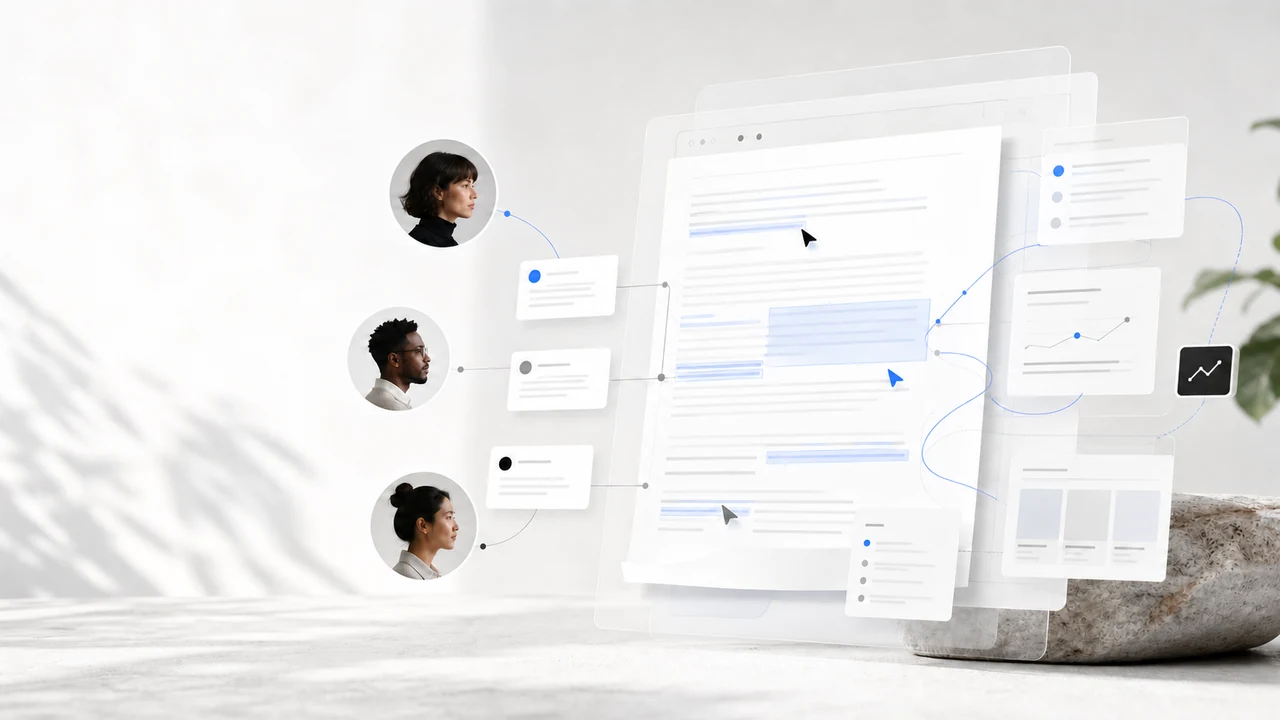
Multiplayer GEO is a shared workflow where teammates and AI agents use the same live document, brand context, source evidence, and approval trail to improve how a company appears in AI-generated answers. People set direction, validate facts, and approve releases. Agents research, draft, review, and execute repeatable tasks inside the shared workspace.
The goal is not faster AI copy. It is an evidence-backed path from an AI visibility problem to an approved change and a measurable result.
Y Combinator recently called for Multiplayer AI: shared agent sessions that teams can enter, watch, redirect, and hand off. Generative Engine Optimization, or GEO, is one of the clearest applications of that idea because the work already crosses research, content, brand, SEO, technical, review, and publishing teams.
Why is GEO becoming a multiplayer problem?
A buyer asks ChatGPT, Gemini, Perplexity, Claude, or Google an important question. The answer may be shaped by the brand's website, third-party sources, competitor coverage, structured data, internal links, and the language used across the web.
Improving that answer is rarely one person's job.
- A growth lead decides which buyer questions matter.
- An analyst checks which brands appear and which sources are cited.
- A subject expert verifies the claims.
- A writer or agent creates the page.
- An editor checks clarity, structure, and brand voice.
- A technical owner handles metadata, schema, and publishing.
- A team measures whether visibility changes after the work goes live.
A GEO audit can expose the gaps, but diagnosis is only useful if the team can turn it into approved work. That execution layer is where private AI chats start to break down.
What does single-player GEO get wrong?
Most AI visibility workflows still look like this:
- One person finds a problem in a dashboard.
- They open a private chatbot and explain the problem again.
- They copy the answer into a document.
- An editor asks where the claim came from.
- A subject expert edits a different version.
- Someone creates a new task for internal links, metadata, images, or schema.
- The page reaches publishing with half of its original evidence missing.
This creates five recurring failures.
Context is copied instead of shared
The prompt, source, competitor comparison, brand fact, and selected passage live in different places. Every handoff loses information.
Research gets repeated
Several people ask similar questions in separate chats, then reconcile conflicting outputs by hand.
Agent work is invisible
Teammates cannot see the live tool activity, continue the same conversation, or redirect the work before the answer is finished.
Edits become unsafe
An agent can rewrite an old passage after a teammate has already changed it. Without revision awareness, the newest human work can be overwritten.
Recommendations stop before execution
A monitoring dashboard may identify a content or citation gap, but the team still has to move into other tools to research, write, review, approve, publish, and measure the fix.
How is Multiplayer GEO different from AI writing or Google Docs?
Collaborative writing shares the draft. Multiplayer GEO shares the evidence, agent work, decisions, and release path.
| System | Shared document | GEO evidence | Agent uses workspace context | Revision-safe agent edits | Review and release |
|---|---|---|---|---|---|
| Generic AI writer | Limited | No | No | Usually no | Limited |
| Collaborative document | Yes | No | Usually no | Not native | Human workflow only |
| AI visibility dashboard | No | Yes | No | No | Recommendations only |
| Multiplayer GEO | Yes | Yes | Yes | Yes | Human-controlled |
Google Docs solved shared editing. An AI visibility dashboard solves measurement. A generic agent can help with individual tasks. Multiplayer GEO connects those pieces into one controlled operating system for improving AI visibility.
How does a Multiplayer GEO workflow work?
The workflow can begin with a new idea, an existing page, a weak visibility prompt, a GEO audit finding, or a website page that needs to be created.
1. Start from the real opportunity
The team identifies the buyer question, citation gap, competitor advantage, existing page, or new topic that deserves attention. The opportunity should connect to a real audience and product, not just a keyword.
2. Bring the evidence into one place
The workspace gathers relevant brand facts, visibility answers, citations, competitor pages, internal content, uploaded files, and live research. This matters because AI platforms decide what to cite from a broader source environment, not from one isolated draft.
3. Agree on the plan before drafting
The team reviews the angle, intent, audience, outline, sources, and desired action. Agents can research in parallel, but people decide what is worth saying.
4. Create or improve the content together
Teammates and agents work in the same document. A collaborator can select an exact passage, leave a comment, or ask the agent for a focused edit without explaining the full article again.
5. Keep agent changes reviewable
An agent edit is saved as a proposal against a specific revision. People can compare what was inserted and removed, then accept or reject it. If the document has changed, the proposal should be marked stale instead of silently overwriting newer work.
6. Run the right reviews
Basic checks cover structure, links, metadata, alt text, and readability. Deeper reviews can examine approved facts, content depth, competitors, SEO, answer-engine usefulness, and brand voice.
7. Finish the release package
The team reviews internal links, images, title, description, slug, canonical URL, and format-specific structured data. The page moves forward only when the named revision is ready.
8. Approve and publish
An authorized person approves the release. The approved revision can then move into a supported website or content management workflow.
9. Measure what changed
After the page is live and has had time to be discovered, the team returns to the relevant prompts, answers, citations, rank, and source patterns. This closes the loop from observation to execution and learning.
What do people own, and what do agents do?
Multiplayer does not mean removing human responsibility. It means giving people and agents clear roles inside the same workflow.
| People own | Agents help with |
|---|---|
| Strategy and priorities | Research and evidence gathering |
| Brand truth and judgment | Drafting and rewriting |
| Sensitive claims | Structural and factual checks |
| Approval and accountability | Internal-link and source recommendations |
| Final release | Repetitive execution and follow-up analysis |
People remain accountable for what the company says. Agents reduce the distance between a decision and the work required to carry it out.
How does ReachLLM implement Multiplayer GEO?
ReachLLM approaches Multiplayer GEO as a shared execution layer across the full Observe, Diagnose, Execute workflow.
In Content Studio, teams can work from one live document with:
- real profile photos and live presence for active collaborators
- an embedded ReachLLM Agent that can use the current document and selected passage as context
- selected passages attached to the agent as quoted context
- approved brand facts, writing style, competitors, website pages, connected search data, AI visibility research, and uploaded sources
- agent edits saved as reviewable proposals against a specific revision
- anchored comments, replies, mentions, ownership, and resolution history
- basic and deep review across structure, facts, voice, SEO, AEO, competitors, and content depth
- internal-link recommendations from real website and content context
- visible inspiration and source provenance
- brand-aware image creation and reference uploads
- metadata, image, and structured-data release checks
- human approval tied to the exact revision being published
The embedded agent is the same ReachLLM Agent used elsewhere in the platform, with additional document context and dedicated Content Studio actions. The product documentation explains the current Content Studio workflow, ReachLLM Agent behavior, and team access model.
That shared context is the difference between a chatbot that writes text and a system that helps a team ship accountable GEO work.
What Multiplayer GEO does not mean
The category is powerful, but the limits matter.
- It does not mean unsupervised publishing.
- It does not make every generated statement true.
- It does not let anyone enter a workspace without project access.
- It does not guarantee a citation, ranking, or visibility increase.
- It does not make schema or
llms.txta substitute for useful content and trusted sources. - It does not replace marketers, editors, technical owners, or subject experts.
Structured data can help search systems understand a page, but it must match the visible content and remain accurate. Useful content, credible sources, clear entity signals, and human judgment still matter.
Why does Multiplayer GEO matter now?
AI agents are moving from short answers to work that spans many steps and many hours. As Y Combinator's Multiplayer AI request argues, that work needs shared visibility, control, redirection, and handoff.
GEO already has those coordination requirements. The outcome depends on a sequence of decisions across visibility data, source evidence, content, technical implementation, approval, and measurement.
That work should not live in thousands of private prompts.
The shift is straightforward:
- from private prompts to shared context
- from invisible rewrites to reviewable proposals
- from disconnected recommendations to approved execution
- from AI writing to Multiplayer GEO
ReachLLM has been building toward that model: one shared document, an embedded agent with workspace context, real brand and visibility data, and human approval at the center.
Frequently asked questions
What is Multiplayer GEO?
Multiplayer GEO is a shared workflow where teammates and AI agents use the same live document, brand context, source evidence, comments, reviews, and approval trail to improve how a brand appears in AI-generated answers.
How is Multiplayer GEO different from an AI content writer?
An AI content writer mainly produces text. Multiplayer GEO connects research, visibility evidence, brand knowledge, collaborative editing, revision-safe agent proposals, review, publishing, and follow-up measurement.
How is Multiplayer GEO different from Google Docs?
Google Docs shares the document and human editing activity. Multiplayer GEO also shares the AI agent session, GEO evidence, brand context, review findings, source provenance, release checks, and approved publishing path.
What information can a Multiplayer GEO agent use?
Depending on the connected workspace, an agent can use the active document, selected passage, approved brand facts, writing style, competitors, website pages, uploaded files, connected search data, visibility prompts, answers, citations, and source research.
Can an AI agent publish changes without approval?
Not in the ReachLLM workflow described here. Agent edits remain proposals, and an authorized person approves the exact revision before it moves into the supported publishing path.
Does Multiplayer GEO replace SEO or content teams?
No. It gives SEO, content, brand, technical, and subject-matter teams a shared execution surface. People keep responsibility for strategy, truth, judgment, and release while agents help with research, drafting, checking, and repetitive work.