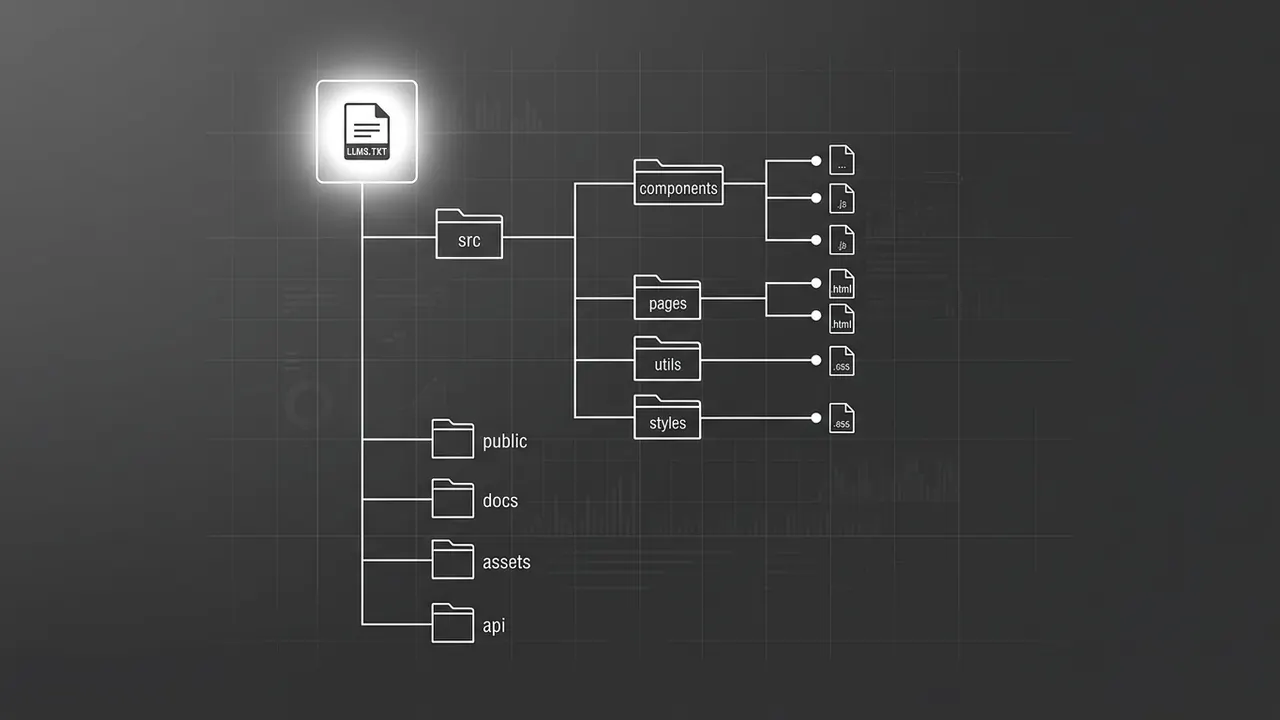
You have a robots.txt that tells Google what to crawl. You have a sitemap.xml that tells search engines where your pages are. But what do you have that tells AI models what your brand actually does?
For most websites, the answer is nothing.
That's the problem llms.txt solves.
What is llms.txt?
llms.txt is a plain text file you place at the root of your website. It gives AI models a clear, structured description of your business, your products, and your key information. Think of it as a cover letter for your brand, written specifically for ChatGPT, Gemini, Claude, and Perplexity.
The format is simple. A markdown file at yoursite.com/llms.txt that includes your brand name, what you do, your core offerings, and links to your most important pages.
Here's the key difference from a regular About page: llms.txt is designed for machine readability. It strips away the navigation, the CTAs, the design elements, and gives AI models the clean signal they need to understand your business.
Why AI models need this
When someone asks ChatGPT "What's the best project management tool for remote teams?" the model doesn't visit your website and read it like a human would. It pulls from training data, retrieval sources, and cached information to construct an answer.
If your brand information is scattered across dozens of pages, buried in marketing copy, or inconsistent across sources, the model's understanding of what you do gets blurry. Blurry means you don't get recommended.
llms.txt fixes this by giving AI one authoritative, concise source of truth about your brand. It reduces ambiguity. It makes it easier for models to categorize you, describe you accurately, and include you in relevant recommendations.
What goes in an llms.txt file
A good llms.txt file covers five things:
-
Brand identity. Your company name, a one-line description, and your category. Don't be clever. Be clear.
-
Core offerings. What you sell or do, described in plain language. Not marketing copy. Not taglines. Straightforward descriptions that an AI model can parse without interpretation.
-
Key differentiators. What makes you different from competitors. This is where entity signals matter. If you don't state your differentiators clearly, AI models have to guess from third-party sources.
-
Important links. Pages you want AI models to prioritize when building their understanding of your brand. Pricing pages, product pages, case studies, documentation.
-
Structured facts. Founding year, location, team size, notable customers, certifications. Concrete details that anchor your brand identity in the model's representation.
The robots.txt parallel
robots.txt became standard because webmasters realized they needed to communicate with crawlers directly. You couldn't just hope Google would figure out which pages to index and which to skip.
llms.txt follows the same logic for AI. You can't hope that ChatGPT or Perplexity will piece together an accurate picture of your brand from scattered web pages. You give them the information directly.
The difference is stakes. A bad robots.txt means Google indexes the wrong pages. Missing llms.txt means AI models describe your brand inaccurately, or skip you entirely when recommending solutions in your category.
How llms.txt fits into GEO
llms.txt is one piece of a larger strategy called Generative Engine Optimization. GEO is the practice of making your brand visible and accurately represented in AI-generated answers.
Here's how llms.txt connects to the broader GEO workflow:
Diagnosis. When we audit a brand's AI visibility, one of the first things we check is whether AI models describe the brand accurately. llms.txt directly improves this by giving models a clean source of truth.
Entity consistency. AI models build an internal representation of your brand from multiple sources. If your own website sends a clear, structured signal through llms.txt, it anchors that representation. Third-party inconsistencies become less damaging.
Citation pathways. When Perplexity generates an answer and cites sources, llms.txt gives it a single page that contains everything relevant. That increases the likelihood of your brand appearing in cited responses.
Common mistakes
Most early llms.txt files fall into the same traps:
Too much marketing language. AI models don't respond to hype. Phrases like "industry-leading" or "best-in-class" add noise, not signal. Write like you're explaining your business to a smart colleague, not pitching an investor.
Too vague. Saying "we help businesses grow" tells an AI model nothing useful. Say what you actually do, for whom, and how. Specificity is what drives recommendations.
Set and forget. Your offerings change. Your positioning evolves. llms.txt needs to be updated when your business changes, just like any other piece of critical infrastructure.
Ignoring the full context. llms.txt helps, but it's not magic. If every other source on the web describes your brand differently, one file won't override that. It works best as part of a broader GEO strategy that aligns all your signals.
Who should create one today
Every business that wants to appear in AI-generated recommendations. That's not an exaggeration.
If you're a SaaS company and people ask AI which tools to use, you need llms.txt. If you're a local business and people ask AI for nearby options, you need llms.txt. If you're a service provider and people ask AI who to hire, you need llms.txt.
The businesses that move first get an advantage. AI models are forming their understanding of every brand right now. The clearer your signal, the more likely you are to be included when it matters.
Getting started
Creating an llms.txt file takes less than an hour. Here's the process:
- Write a clear, one-paragraph description of your business. No jargon, no buzzwords.
- List your core products or services with plain descriptions.
- State your key differentiators in factual terms.
- Include links to your most important pages.
- Add concrete facts: founded date, location, team size, notable clients.
- Save it as llms.txt and place it at your domain root.
- Test it by asking ChatGPT and Perplexity about your brand and noting any gaps.
That gets you the foundation. From there, GEO work builds on top of it by optimizing how AI models find, interpret, and cite your brand across all their sources.
ReachLLM is an AI-native GEO agency that gets brands recommended by ChatGPT, Gemini, Claude, Perplexity, and Google AI Overviews. Get your free AI visibility report.